
01LLM Evaluation Platform

LLM Reliability + EvalOps Platform

Full-stack LLM evaluation platform with versioned datasets, graders, quality gates, and cost-latency analysis.
  • Python
  • FastAPI
  • PostgreSQL
  • Next.js
  • TypeScript
Ownership
Owned project
Timeline
August 2026
Status
Live reference implementation
LLM Reliability + EvalOps Platform
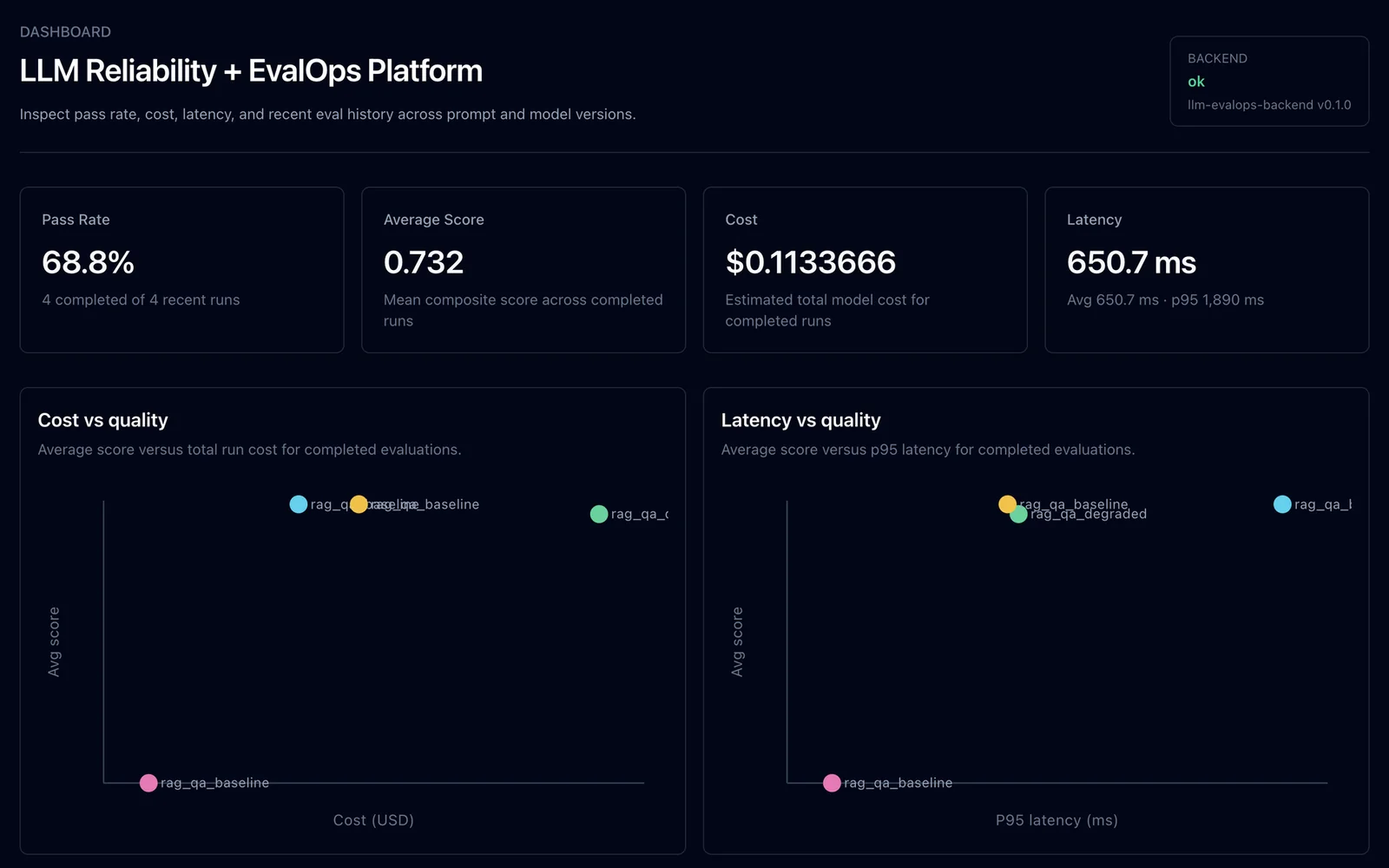
LLM EvalOps dashboard showing pass rate, cost, latency, and recent evaluation runs using demo data.

Synthetic/demo evaluation data shown in the public reference implementation.

Overview

A Next.js, FastAPI, and PostgreSQL reference implementation for measuring the quality, reliability, estimated cost, and latency of LLM-powered workflows across versioned datasets, prompts, models, and graders.

Problem

LLM changes can improve one metric while quietly degrading reliability, cost, or latency. Teams need reproducible evaluation runs, failed-example inspection, and explicit release gates rather than anecdotal prompt testing.

My role

Designed and built the full-stack reference platform, evaluation runner, grader system, analytics UI, persistence layer, and CI quality-gate workflow.

System architecture

Inputs

Versioned inputs

API

FastAPI control plane

Runner

Evaluation runner

Graders

Grader layer

Store

PostgreSQL / Alembic

Analytics

Next.js analytics

Gate

CI quality gate

What I built

  • Versioned datasets, prompt versions, and model configurations.
  • Synchronous evaluation runs with result, estimated-cost, and latency tracking.
  • Exact-match, JSON-schema, text-similarity, citation/grounding, and optional Gemini LLM-as-judge grading.
  • Composite scoring, run history, breakdowns, and failed-example analysis.
  • Cost-versus-quality and latency-versus-quality comparisons.
  • A CI evaluation-gate CLI with pass-rate, score, cost, and p95 thresholds, stable exit codes, and JSON reports.
  • Document-grounded RAG QA using supplied documents rather than a vector database.
  • Next.js dashboard, FastAPI API, PostgreSQL persistence, and Alembic migrations.
  • Vercel/Cloud Run packaging and GitHub Actions validation.

Technical decisions

  • Version artifacts so comparisons can be reproduced.
  • Combine deterministic graders with an optional model-based judge rather than making every evaluation provider-dependent.
  • Give CI gates stable exit codes and JSON reports for automation.
  • Keep document-grounded RAG QA tied to supplied documents rather than suggesting a general vector-search platform.
  • Surface cost and latency next to quality so one-dimensional improvements are visible.

Testing and validation

  • Fixed 20-case RAG QA dataset held constant across both recorded runs.
  • Baseline run: 95.0% pass rate, 0.987 average score, 1 failed case, $0.02939670 estimated cost, 745.5 ms average latency, 867 ms p95.
  • Intentionally degraded prompt: 85.0% pass rate, 0.953 average score, 3 failed cases, $0.06300110 estimated cost, 808.15 ms average latency, 908 ms p95.
  • Both recorded runs reported zero provider errors.
  • 221 backend tests and a successful frontend production build at the evidence snapshot.

Measured evidence

  • 95.0% → 85.0%

    Pass rate, baseline vs degraded prompt

    Repository-recorded 20-case RAG regression documented on 2026-08-05.

    Controlled comparison, not a customer or usage metric.

  • 1 → 3

    Failed cases across the same dataset

    Same fixed 20-case dataset; only the prompt version changed.

  • $0.0294 → $0.0630

    Estimated run cost

    Estimated model cost recorded by the runner for each of the two runs.

    Estimate produced by the platform, not a billed amount.

  • 221

    Backend tests

    Latest successful main-branch Backend CI run 32046570725 (2026-08-17), rechecked 2026-08-18.

    Point-in-time count, not a live counter.

A reproducible way to compare prompt and model versions on quality, cost, and latency together, with a CI gate that fails a change before it ships rather than after.

Limitations

  • A reference implementation seeded with synthetic data, not a product.
  • No general-purpose authentication or secure multi-tenant boundary is claimed.
  • Public write endpoints would require authentication, authorization, rate limits, audit logging, and threat-model review.
  • The runner is synchronous. One documented run of approximately 16 minutes outlasted its initiating browser request; production scale would require asynchronous workers and polling.
  • No enterprise SaaS, production multi-tenancy, or large-scale usage is claimed.

Technology stack

  • Next.js
  • FastAPI
  • PostgreSQL
  • Python
  • TypeScript
  • Alembic
  • Docker
  • GitHub Actions
  • Vercel
  • Google Cloud Run

Data and privacy

Seeded with synthetic evaluation data. No customer content, credentials, or production traffic is present in the public deployment.